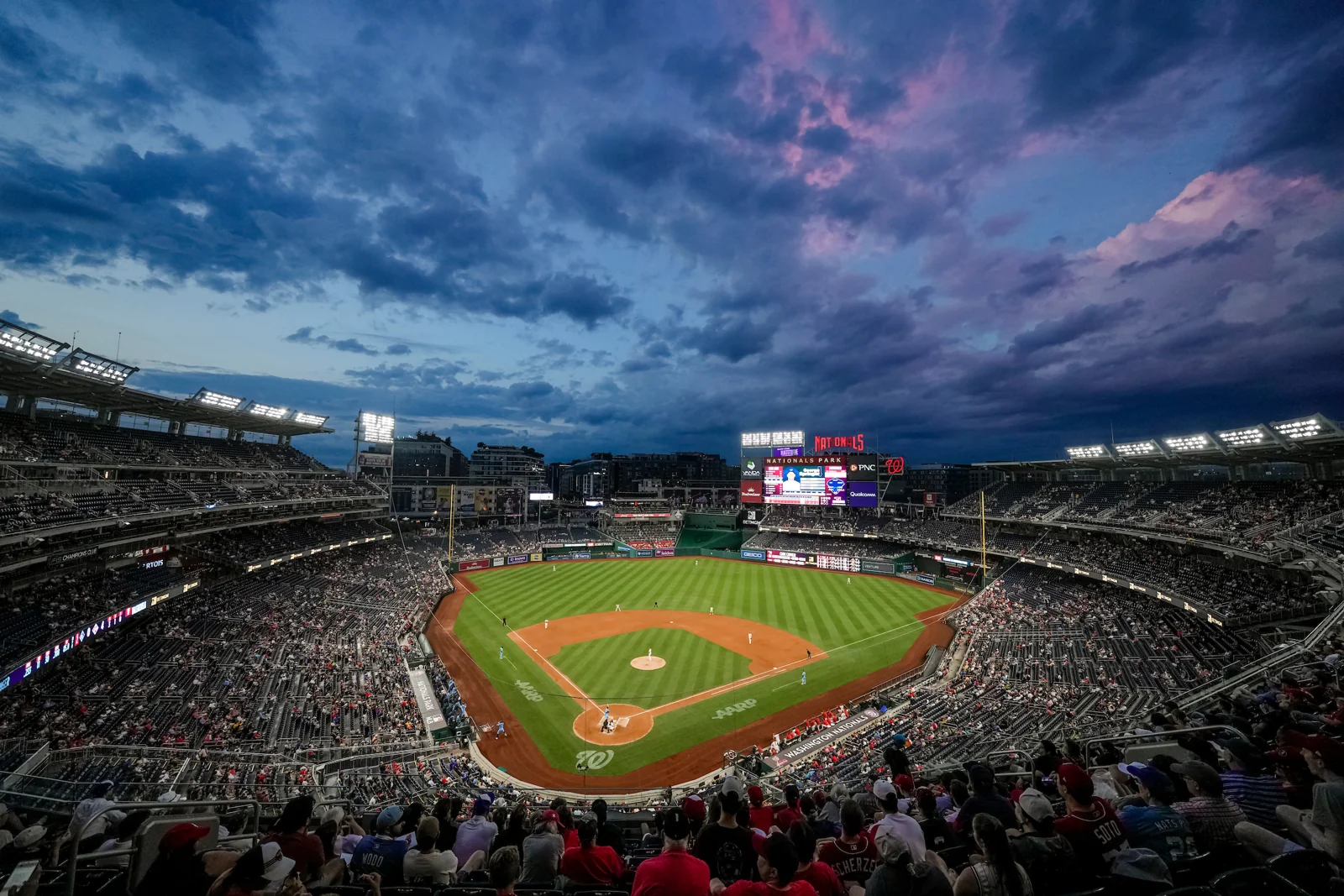
spaceNEXT returns February 16–18, 2027, at Nationals Park in Washington, D.C.
New season. New home field. Serious opportunity.
The next Space Age isn’t something we simply witness. It’s something we shape.
From laboratories and factory floors to boardrooms and halls of government, people across the world are turning extraordinary possibilities into reality—and redefining what humanity can accomplish.
In 2027, spaceNEXT brings those people together at Nationals Park in Washington, D.C., February 16–18. Government, industry, academia, and investment. Leaders from across the United States and around the world. People with different expertise and a shared reason to be in the room: to exchange ideas, forge relationships, and move ambitious work forward.
The work spans manufacturing, logistics, communications, energy, research, computing, and more. The questions reach beyond what technology can do to what people choose to build with it—and how we turn a promising breakthrough into something useful, viable, and widely available.
Last season set the stage
The inaugural spaceNEXT brought together 500 attendees, 100 speakers, and 40 sessions, with 18 countries represented.
That’s a strong opening lineup. But the real story was what they came to discuss.
Across the 2026 program, leaders tackled the infrastructure, investment, technology, talent, and policy needed to build a sustainable, scalable space economy. Among the highlights:
- NASA’s next chapter. NASA Associate Administrator Amit Kshatriya connected Artemis to the infrastructure needed for the next era of commercial and allied space exploration—looking beyond individual missions to what they make possible.
- Computing beyond Earth. Axiom Space’s Jason Aspiotis explored the path toward orbital data centers, including the economic realities that will determine whether computing infrastructure in space can scale.
- Quantum, from ground to orbit. IonQ’s Jordan Shapiro outlined a vision spanning computing, networking, security, sensing, and space infrastructure, connecting emerging capabilities to commercial opportunity.
- Capital with a longer view. E2MC’s Raphael Roettgen examined what it will take for space to become a broadly investable asset class, bringing the conversation back to business models, investor confidence, and growth.
And that was only part of the program. Conversations ranged from space-based power and lunar infrastructure to Earth observation, workforce development, regulation, and the partnerships needed to move new technologies into use.
The takeaway: extraordinary possibilities become real through the work of people with different capabilities—and the relationships that connect them.
Serious players. Across the lineup.
The 2026 speaker roster brought together leaders from government, industry, investment, and research. Selected speakers included:
- Senator Mark Warner — U.S. Senator for Virginia
- Amit Kshatriya — NASA
- Leena-Kaisa Mikkola — Ambassador of Finland to the United States
- Nina Albert — District of Columbia
- Namgya Khampa — Embassy of India
- Arpan Sura — Federal Communications Commission
- Jason Aspiotis — Axiom Space
- Ron Birk — The Aerospace Corporation
- Jacob Bleacher — NASA
- Bianca Cefalo — Space DOTS
- Raphael Roettgen — E2MC
- Jordan Shapiro — IonQ
These names reflect the 2026 roster and affiliations at the time of the event. Watch for separate announcements of the 2027 lineup.
A global economy needs a global lineup
Eighteen countries were represented at spaceNEXT 2026. The national updates made clear why that matters: the capabilities, companies, and partnerships shaping the space economy are coming from every direction.
From lunar infrastructure to satellite services and launch sites, countries brought distinct strengths—and clear ambitions—to the conversation:
- Australia brought the launch-and-return advantage. Its update explored how geography, U.S. partnerships, and emerging infrastructure are positioning the country to support everything from lunar exploration to manufacturing in orbit and returning products to Earth.
- Italy brought industrial depth. Lunar habitation, commercial space stations, propulsion, and transatlantic investment showed how an established space power is building for the next era of exploration and commerce.
- India brought scale and ambition. Its update connected lunar achievements and a growing private space sector with expanding U.S. cooperation—and a national goal of a $44 billion space economy by 2033.
- Finland brought the research-to-market story. From student satellites to commercial Earth observation and space-weather expertise, its update showed how deep scientific capabilities can help build a globally connected business ecosystem.
- The Netherlands brought precision and partnership. Advanced engineering, contributions to Artemis, and strong international relationships demonstrated how a highly specialized ecosystem can play an outsized role.
- Sweden brought an Arctic advantage. National satellite ambitions, dual-use innovation, and expanding launch infrastructure underscored its growing role across commercial space, research, and security.
Different nations. Expanding possibilities.
These updates put real capabilities and potential partners behind the phrase “global space economy.” They showed how the next Space Age is being shaped across borders—in laboratories, companies, public institutions, and the partnerships between them.
The organizations behind the momentum
The 2026 sponsor and exhibitor community brought together space companies, investors, universities, professional services firms, and regional economic development organizations.
Selected 2026 sponsors and partners included:
- Capella Space and IonQ — Pioneer sponsors
- George Mason University — Lead Academic Partner
- Arkenstone Capital, MITRE, Rogue Space Systems, and Universities Space Research Association (USRA) — Voyager sponsors
- Aliro, E2MC, Holland & Knight, Harmonia Holdings, and Maryland Aerospace Alliance — among the Pathfinder sponsors
- Fairfax County Economic Development Authority, Howard County Economic Development Authority, Loudoun County Economic Development, and Montgomery County Economic Development Corporation — among the regional sponsors
- SpaceNews — Media Partner
The 2026 exhibitor roster also included Diffraqtion, JivaJet, RS&H, SylLab Systems, the University of Maryland, and Greater Washington Build Here, alongside organizations participating across the sponsor community.
Together, they reflected the range of organizations with a stake in the space economy—from emerging technologies and mission capabilities to talent, infrastructure, and business growth.
Explore the 2026 speakers, sponsors, exhibitors, and session recaps.
In 2027, we’re bringing that ecosystem to the ballpark
Nationals Park gives the next spaceNEXT a distinctly Washington home field.
The setting is new. The purpose is clear: bring people together who can connect what each is doing with what they can accomplish together.
Expect pre-day workshops on February 16, followed by morning plenary programming and afternoon breakout tracks on February 17–18. The format creates room for shared conversations about where the space economy is going—and deeper discussions about how to get there.
This is a gathering for the people designing the systems, financing the companies, shaping the rules, developing the talent, and finding the customers. The opportunity is to challenge assumptions, find collaborators, and take the next step on work that matters.
Already working in space? Bring what you’re building.
Exploring where your industry fits? Bring the questions that could become your next opportunity.
At spaceNEXT, worlds converge.
In Washington, D.C., where decisions carry consequences far beyond national borders, leaders from government, industry, academia, and investment come together from across the United States and around the world. Here, access becomes opportunity: to exchange ideas, forge relationships, and move ambitious work forward.
An initiative of Connected DMV’s Potomac Center for the New Space Economy, spaceNEXT is part of a broader effort to grow space-based enterprise and innovation in Greater Washington.
The region’s concentration of science, industry, public institutions, capital, and policy gives that gathering particular purpose. The decisions reach far beyond the region. So do the opportunities.
Put it on the calendar. Get in the lineup.
February 16–18, 2027. Nationals Park. Washington, D.C.
Save the dates, sign up for season updates, and explore opportunities to speak or sponsor.
There is plenty left to imagine. And work worth coming together to do.
What’s next in space starts now.